Copper + Zinc in Water Treatment: Where They Fit—and Where They Don’t
When we started talking about emergency water treatment, one question kept coming up:
Could copper and zinc become another layer in the process?
The answer is interesting.
Yes—but not as a substitute for filtration, purification or disinfection.
Copper and zinc really are used in established water-treatment technologies. The key is understanding how they are used, what they can accomplish, and why dropping pieces of metal into questionable water is not the same thing as using a properly engineered treatment system.
If you haven’t already, start with Water Purification for Beginners: How to Make Emergency Water Safer to Drink. That article covers the foundation: source selection, pre-filtering, filtration or purification, disinfection and safe storage.
This article is about an additional treatment layer.
Why Copper Shows Up in Water Treatment
Copper has antimicrobial properties, which is one reason it has been studied and used in specialized water-treatment systems.
One established example is copper-silver ionization.
In these systems, controlled concentrations of copper and silver ions are introduced into building water systems to help control microorganisms such as Legionella. EPA includes copper-silver ionization among technologies used for Legionella control in premise plumbing, alongside chlorine, monochloramine, chlorine dioxide, ultraviolet light and ozone. EPA does not, however, recommend one specific Legionella-control technology over the others.
CDC also notes that copper-silver ions have limited Legionella growth in laboratory and operating conditions, while emphasizing that these methods are specialized supplemental treatments rather than a universal substitute for conventional disinfection.
So there is legitimate science behind copper’s antimicrobial role.
But notice something important:
It is controlled technology.
It is not simply placing copper wire or pennies into a water container and assuming the water has become safe.
Then Where Does Zinc Come In?
This is where another type of water-treatment technology becomes interesting.
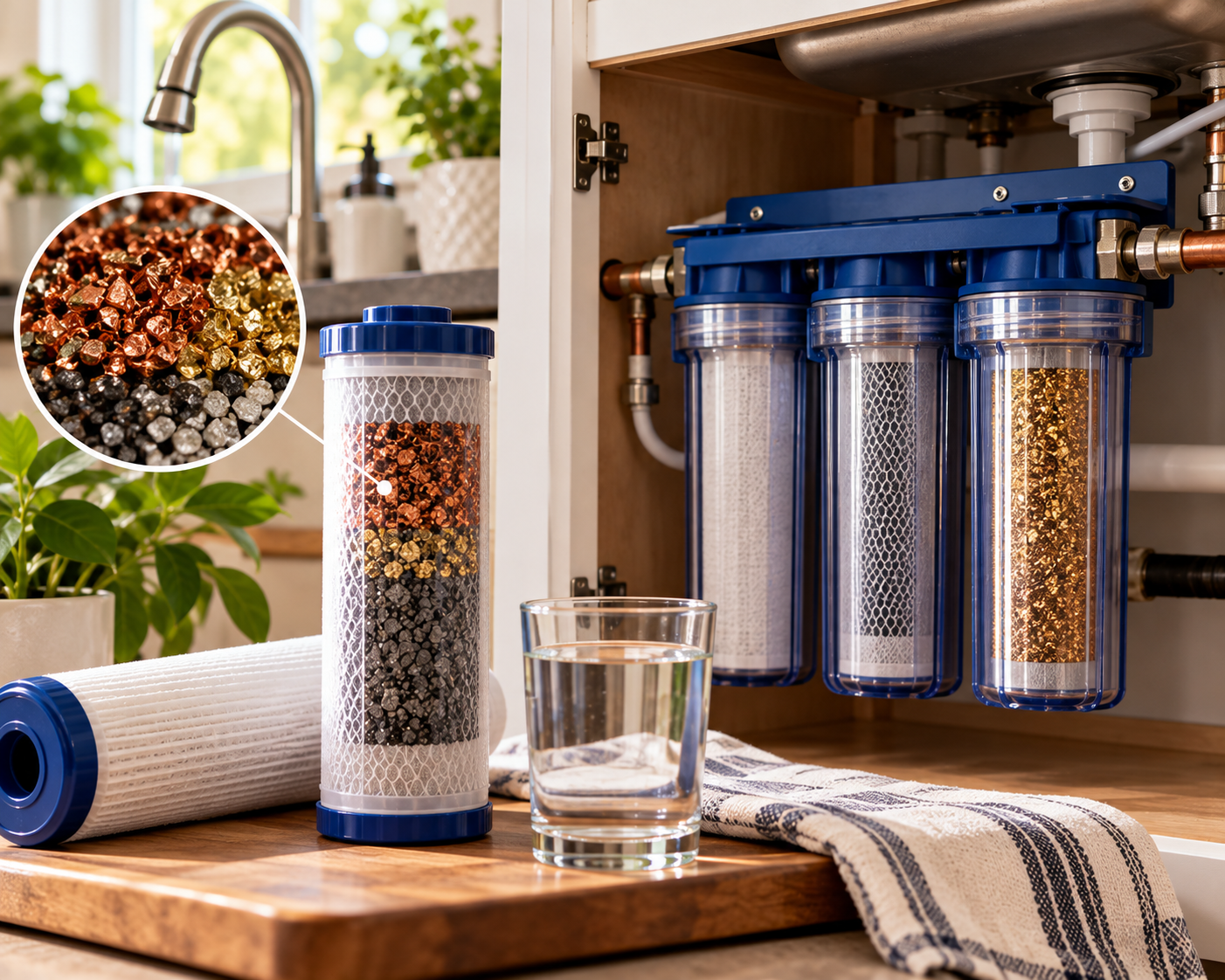
Some filtration systems use copper-zinc redox media.
One well-known form is commonly called KDF process media. It consists of copper and zinc in granular form and is incorporated into certain filtration systems as part of a multistage treatment process.
NSF’s current listings include KDF 55 copper-zinc redox media under NSF/ANSI 42 for residential drinking-water treatment components.
But there is an important detail here.
NSF/ANSI 42 primarily covers aesthetic effects, such as chlorine, taste and odor reduction. It should not be confused with standards addressing contaminants with health effects or microbial purification.
In other words:
Seeing copper-zinc media inside a water filter does not automatically mean that filter is a microbiological water purifier.
You still have to look at the claims and certifications for the complete system.
What Does “Redox” Mean?
The term redox comes from reduction-oxidation.
Very simply, electrons move between substances during a redox reaction.
Copper-zinc filtration media are engineered to use these electrochemical reactions as water passes across the media.
That makes copper and zinc useful as treatment media, particularly when incorporated into systems designed around their chemistry.
This is very different from the mechanical action of a membrane filter.
A membrane may physically block microorganisms or particles based on pore size.
Activated carbon works largely through adsorption.
UV treatment uses ultraviolet energy to inactivate microorganisms.
Copper-zinc redox media work through another mechanism altogether.
And that is exactly why layered water treatment is so interesting:
Different technologies solve different problems.
Copper + Zinc Are Not the Same as a Water Purifier
This is the distinction I want to make crystal clear.
If you have questionable emergency water that may contain disease-causing bacteria, viruses or parasites, you should not rely on copper-zinc media alone to make that water safe to drink.
For emergency microbiological treatment, use methods specifically designed and validated for that purpose, such as an appropriate water purifier, boiling, or another recognized disinfection method.
That is why our basic system remains:
Source → Pre-filter → Filter/Purify → Disinfect when necessary → Store safely
Copper-zinc treatment, when present in an engineered system, would sit within that larger treatment train.
It doesn’t replace the train.
Could Copper + Zinc Be an Additional Layer?
Yes. This is the part that originally caught my attention.
Imagine a multistage household treatment system.
Water might move through:
sediment filtration,
then copper-zinc redox media,
then activated carbon,
then a fine membrane or purifier,
and perhaps another validated disinfection stage depending on the system and intended water source.
Each stage has a different job.
The copper-zinc layer might contribute to the conditioning or treatment occurring before later filtration stages.
That can make sense.
What does not make sense is turning the concept into:
“Add copper and zinc to dirty water and drink it.”
Those are two very different ideas.
There Is Another Reason Not to DIY the Metal Layer
More is not necessarily better.
Copper itself can become a drinking-water contaminant at excessive concentrations.
EPA’s current drinking-water rules use a copper action level of 1.3 mg/L at consumer taps.
The World Health Organization also maintains guidance for copper in drinking water and notes that excessive copper can cause gastrointestinal effects.
Zinc is an essential nutrient and WHO has not established a health-based drinking-water guideline at the concentrations ordinarily found in water, although higher zinc levels can make water unpleasant in taste and appearance. WHO notes that water above roughly 3 mg/L may become unacceptable to consumers.
So the goal is not to create water with “lots of copper and zinc.”
The goal in an engineered system is to use those materials in a controlled treatment process.
Don’t Confuse Copper-Zinc With Copper-Silver
These two technologies sound similar, but they should not be lumped together.
Copper-silver ionization uses controlled metal ions primarily as a microbial-control technology in certain building water systems.
Copper-zinc redox media are filtration media used within certain water-treatment systems.
They involve different combinations of metals, different mechanisms and different applications.
That distinction matters when you’re evaluating products.
A filter that advertises “copper-zinc media” should not inherit the claims of a professional copper-silver Legionella-control system simply because both contain copper.
Certification Matters More Than the Ingredient List
This may be the biggest takeaway of the entire article.
Do not buy a water-treatment product because the marketing page contains impressive words like:
“copper,”
“zinc,”
“antimicrobial,”
“mineral,”
“redox,”
or even “purification.”
Instead, ask:
What specific contaminant is this complete system tested or certified to reduce?
NSF explains that different drinking-water standards address different functions. NSF/ANSI 42 generally relates to aesthetic effects such as chlorine and taste/odor; NSF/ANSI 53 addresses contaminants with health effects; NSF/ANSI 55 covers certain ultraviolet microbiological treatment systems; and NSF/ANSI 58 applies to reverse-osmosis systems.
That’s much more useful than a list of impressive filter ingredients.
So Where Would Copper + Zinc Fit in a Preparedness Plan?
For most families, I would think of it this way:
Your primary emergency-water strategy is still stored water plus a dependable method of treating additional water.
Start with Water Storage for Beginners: How Much Water Does Your Family Really Need?
Then understand your primary treatment options through Water Purification for Beginners: How to Make Emergency Water Safer to Drink.
Only after those basics are covered does it make sense to explore technologies such as copper-zinc redox media as an additional layer in a larger filtration system.
That’s the order that keeps this practical.
Layering Is the Real Lesson
The most useful discovery here is not that copper and zinc are some forgotten emergency-water secret.
They aren’t.
The useful discovery is that good water treatment often relies on multiple barriers.
WHO’s drinking-water guidance specifically emphasizes preventive risk management and treatment systems built around multiple barriers rather than assuming one intervention can address every hazard.
That is exactly how I want to approach water preparedness at Rooted & Ready.
Not:
“Which one filter will save us?”
But:
What is our safest source?
What contaminants are we concerned about?
What does each treatment layer remove or control?
Where are the gaps?
What is our backup if one layer fails?
That is a much stronger system.
And, frankly, it’s much more peaceful than betting your family’s drinking water on one gadget—or one internet trick.
A Simple Rooted & Ready Water Strategy
Think of your household water plan in three parts:
Store it. Treat it. Understand it.
Store enough safe water to give yourself breathing room.
Know how to treat additional water if necessary.
And understand exactly what your equipment can and cannot do.
If you’re organizing those pieces inside your Rooted & Ready Emergency Preparedness Workbook, record the treatment method, replacement schedule and stated contaminant-reduction claims for every water device you own.
That way, six months from now, you don’t have to remember what that mysterious filter cartridge in the preparedness bin was supposed to do.
😂
Affiliate Disclosure
Some links in this post may be affiliate links. If you make a purchase through one of these links, Rooted & Ready may earn a small commission at no additional cost to you. We only share products we believe may support peaceful, practical preparedness.