Water Storage for Beginners: How Much Water Does Your Family Really Need?
When people begin preparing for emergencies, water can feel surprisingly complicated.
How much do you really need? Where are you supposed to put it? Can you keep it in the garage? Do you need bottled water, storage containers, filters, purification tablets—or all of the above?
The good news is that you do not have to build the perfect water system overnight.
Preparedness can begin with one simple goal:
Make sure your family has safe water available if the faucet suddenly stops working.
Whether the disruption lasts a few hours, several days, or longer, having water already stored at home gives you time to think clearly instead of scrambling for one of life’s most basic necessities.
How Much Emergency Water Should You Store?
The CDC recommends storing at least one gallon of water per person per day for a minimum of three days and, when possible, working toward a two-week supply. Families living in hot climates, households with pets, and people with certain health or medical needs may need additional water.
That gallon is not only for drinking.
Your emergency water may also be needed for:
- preparing food
- brushing teeth
- taking medications
- limited hygiene
- washing hands
- caring for children
- providing water for pets
For a family of four, the basic three-day recommendation is already 12 gallons.
A two-week supply would be 56 gallons.
That is why water preparedness becomes much easier when you think in stages instead of trying to purchase everything at once.
Start With Stored Water
Filters and purification tools are valuable, but your first layer should be water that is already available.
During an emergency, there may not be a nearby water source to filter. Municipal water could be temporarily unavailable, contaminated, or inaccessible.
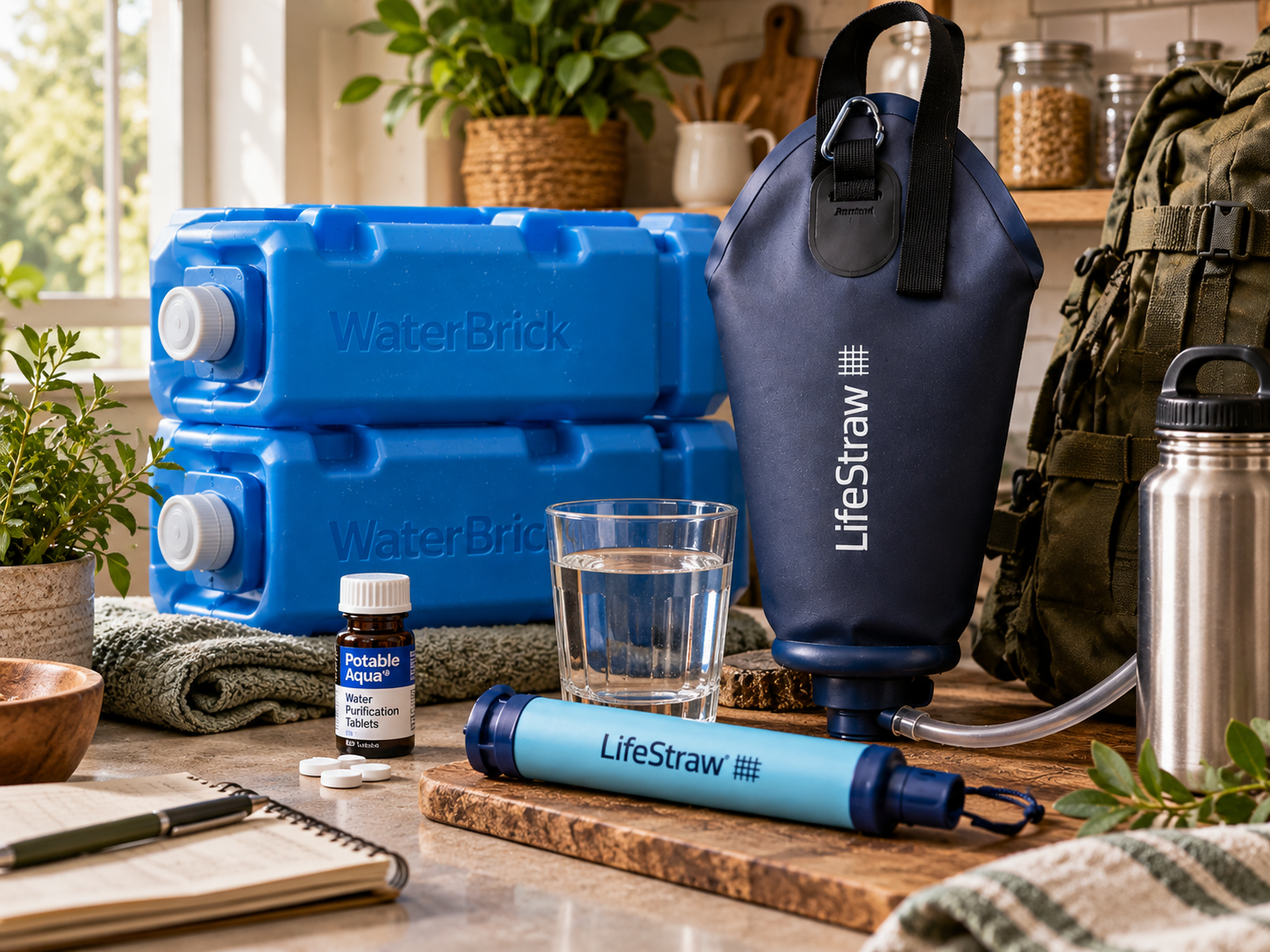
A practical solution such as the WaterBrick 3.5-Gallon Stackable Water Containers – 6 Pack allows a household to store water in smaller, portable containers rather than depending on one extremely heavy tank.
Each WaterBrick holds 3.5 gallons, so a six-pack provides 21 gallons of storage capacity. The containers are designed to stack, which can help households make better use of closets or other limited storage areas.
Smaller containers also have another advantage: you do not have to move an entire large water reserve every time you need water.
Where Should Emergency Water Be Stored?
This part matters more than many people realize.
For home-filled containers, the CDC recommends storing water in a cool location—ideally about 50°F to 70°F—away from direct sunlight and away from gasoline, pesticides, and other toxic substances.
That means a very hot garage—especially one experiencing Texas summer temperatures—is not an ideal primary storage location for drinking water.
Instead, look for unused air-conditioned spaces such as:
- the bottom of closets
- underneath sturdy beds
- pantry storage
- utility-room shelving away from chemicals
- climate-controlled storage areas
- multiple small storage locations throughout the house
Water does not have to live in one giant preparedness closet.
Sometimes the easiest solution is simply spreading your supply throughout the home.
Label and Rotate Home-Filled Water
If you fill your own food-grade water-storage containers, label them with the date they were filled.
The CDC recommends replacing home-filled stored water every six months.
A simple calendar reminder twice a year can take care of this.
When it is time to rotate the water, you do not necessarily have to waste it. Depending on its condition and how it was stored, older water can often be redirected for cleaning, flushing toilets, or watering plants rather than simply poured down the drain.
Stored Water Is Layer One—Not the Whole Plan
A stronger emergency water plan has several layers.
Think of it this way:
Store it. Treat it. Filter it. Purify it when necessary.
Stored water handles the immediate emergency.
Then backup treatment and filtration options give you additional ways to respond if your stored supply runs low.
Water Treatment
Compact Potable Aqua Water Treatment Tablets can be kept with emergency supplies as another water-treatment option.
They take up very little room, which makes them especially useful in a go-bag, vehicle kit, or backup water kit.
Always follow the manufacturer’s instructions carefully, including treatment amounts and required waiting times.
Portable Water Filtration
A LifeStraw Personal Water Filter gives one person an extremely portable filtration option.
LifeStraw’s personal filter uses a 0.2-micron membrane and is designed to reduce bacteria, parasites, microplastics, dirt, sand, and cloudiness. Its membrane is rated for up to 1,000 gallons of water.
One important distinction: the standard LifeStraw is a filter, not a virus-removing purifier.
That difference matters.
When You Need a Higher Level of Water Treatment
For households preparing beyond the basics, a gravity-fed purifier adds another layer.
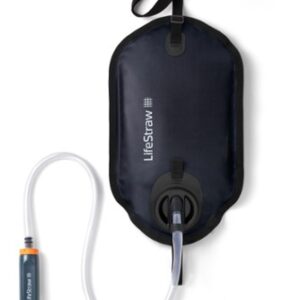
The LifeStraw Ultrafilter Membrane Water Purifier uses an ultrafiltration membrane designed to remove viruses in addition to bacteria and parasites. LifeStraw distinguishes these ultrafilter products from its standard microfilters specifically because the smaller membrane pores also block viruses.
Gravity-fed systems are particularly useful because they can treat larger amounts of water without electricity.
That does not mean every beginner needs one immediately.
It simply gives you somewhere to grow.
Your water plan might begin with bottled water and a few storage containers today and eventually expand into additional filtration, purification, rainwater collection, or larger-capacity storage as your household’s preparedness grows.
Don’t Forget the Water Needed for Food
This is one of the easiest things to overlook.
Your emergency food plan and your emergency water plan are connected.
Many dehydrated and freeze-dried meals require water for preparation. Cooking rice, pasta, oatmeal, dried beans, soups, and other pantry staples requires water too.
So when you calculate your household’s water needs, do not count only what everyone will drink.
Think about what you plan to eat and how you plan to prepare it.
We’ll dig much deeper into that in our upcoming guide, Emergency Food Storage for Beginners: How Much Food Should Your Family Keep?
Build Your Supply Gradually
A complete emergency water setup can sound expensive when you look at everything at once.
So don’t.
Start with what you can reasonably do today.
Buy an extra case of water.
Fill one approved water-storage container.
Add another container next month.
Put a personal filter in your emergency kit.
Add treatment tablets.
Work toward a three-day supply.
Then a week.
Then two weeks.
Preparedness does not have to happen in one shopping trip.
It is built through small, intentional decisions made consistently over time.
Rooted & Ready Action Step
Before buying another preparedness item, calculate your household’s three-day water requirement.
Use:
Number of people × 3 days × 1 gallon = minimum starting supply
Then add water for pets and any additional household needs.
Once you know the number, look around your home and decide where that water can realistically—and safely—be stored.
You do not have to have everything figured out today.
Just take the next wise step.
Prepared in Peace. Rooted in Christ.
Affiliate Disclosure: Some links in this article may be affiliate links. Rooted & Ready may earn a small commission when you make a qualifying purchase through these links, at no additional cost to you. We recommend products we believe may be useful in building practical, peaceful preparedness.
The government guidance behind the water amounts and storage recommendations here comes directly from CDC and Ready.gov: one gallon per person per day for at least three days, with the CDC encouraging a two-week supply when practical.