Emergency Food Storage for Beginners: How Much Food Should Your Family Keep?
Emergency food storage can get confusing fast.
One company sells “60 servings.” Another sells “360 servings.” A bucket promises years of shelf life. A bag says it covers seven days.
But what does any of that actually mean for your family?
That is the question that matters.
Preparedness is not about filling a room with food you may never eat. It is about making sure your household has enough dependable food to get through disruptions without panic.
FEMA recommends keeping nonperishable food for at least several days as part of a basic emergency supply kit. USDA also recommends maintaining foods that do not require refrigeration and remembering special dietary needs, infant food, pet food, and a manual can opener when canned foods are part of the plan.
The goal is not to build the perfect pantry today.
The goal is to start building one that works.
Start With Three Days
For a beginner, three days is a manageable first target.
Think about what your family would actually eat if:
- the electricity went out,
- stores closed temporarily,
- roads became difficult to travel,
- you needed to stay home,
- or you had to leave quickly.
Your first three-day supply does not have to be specialized survival food.
It can include familiar shelf-stable foods such as canned meats, canned fruits and vegetables, peanut butter, crackers, cereal, dried fruit, rice, pasta, shelf-stable milk, and other foods your household already uses. USDA specifically recommends keeping nonperishable foods that can be eaten without refrigeration as part of an emergency supply.
That approach has a big advantage:
You already know your family will eat it.
Build Toward Seven Days
Once you have three days covered, work toward a week.
This is where a dedicated emergency-food option can become useful.
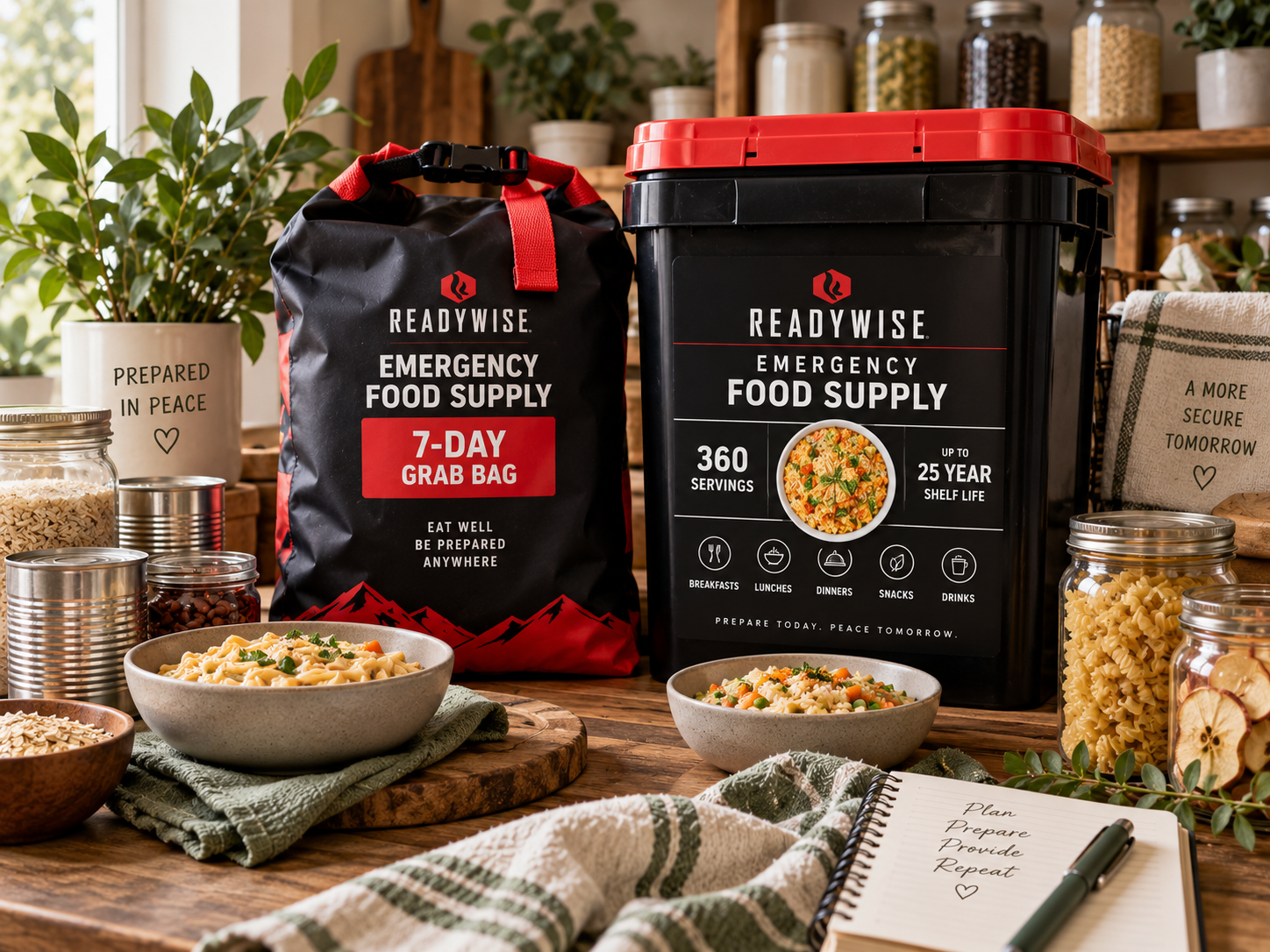
The ReadyWise 7-Day Grab Bag provides about seven days of food for one person at roughly 1,988 calories per day, according to the manufacturer. It is packaged in a portable dry bag and requires about 60 cups of water for preparation.
What I like about that format is not just the food.
It is the mobility.
If you have to evacuate quickly, you are not gathering cans, boxes, and loose pantry items while trying to leave the house.
You can grab the bag and go.
That makes it useful as part of a larger evacuation plan rather than as your only food-storage strategy.
Servings Are Not the Same as Days
This is one of the most important things to understand when comparing emergency food.
A serving is not a day of food.
A product may advertise hundreds of servings, but the number of days it lasts depends on:
- calories per serving,
- total calories in the package,
- how many people are eating,
- age and activity level,
- and whether the food is supplementing other pantry items.
For example, ReadyWise’s 360-Serving Emergency Food Supply contains about 77,420 calories. ReadyWise describes that as roughly 43 days of food at 1,800 calories per day—not 360 days.
That distinction matters.
A family of four would obviously move through that supply much faster than one adult.
So when comparing emergency-food products, look beyond the large number printed on the front.
Ask:
How many total calories are actually here, and how many people am I feeding?
That question will tell you far more than the serving count alone.
Think in Layers
A strong food plan does not depend on one bucket.
It has layers.
Your everyday pantry can form the first layer.
A portable emergency-food kit can form another.
A deeper shelf-stable reserve can provide additional backup if a disruption lasts longer.
That is why I like the progression from something portable like the ReadyWise 7-Day Grab Bag to a larger reserve such as the ReadyWise 360-Serving Emergency Food Supply.
One supports short-term mobility.
The other strengthens your stay-at-home reserve.
Neither replaces the foods you normally eat.
Your Pantry Is Part of Your Emergency Food Supply
Preparedness food does not have to live in a separate room labeled “Emergency.”
Your regular pantry is already part of your preparedness system.
Rice.
Beans.
Pasta.
Oats.
Canned vegetables.
Canned meat.
Soup.
Peanut butter.
Shelf-stable milk.
Flour.
Cornmeal.
Cooking oil.
Seasonings.
These foods may not look like “survival food,” but they can feed a household extremely well during disruptions.
The key is keeping enough on hand and rotating what you use.
A deep pantry also helps during ordinary emergencies:
a job loss, unexpected bills, illness, transportation problems, or a week when grocery money is tight.
Preparedness is not only about disasters.
Sometimes preparedness simply means having enough breathing room.
Do Not Build Your Entire Plan Around the Freezer
Freezers are wonderful—until the electricity goes out.
USDA says an unopened refrigerator generally keeps food safely cold for about four hours. A full freezer can maintain temperature for about 48 hours, or about 24 hours if it is only half full.
That is why shelf-stable food matters.
Frozen meat, vegetables, and prepared meals can absolutely be part of your food plan, especially when you have backup power.
But your household should also have foods that remain usable when refrigeration is unavailable.
Remember the Water
This is where our last article connects directly to this one.
Many emergency foods require water.
ReadyWise estimates approximately one cup of water per serving for many of its meals, and its seven-day grab bag alone requires about 60 cups.
That means food storage and water storage cannot be planned separately.
If you buy dehydrated food without increasing your water reserve, you may have stored plenty of food that you cannot easily prepare.
Whenever you add emergency food, ask:
How much water will this require?
Then add that amount to your household water plan.
Think About How You Will Cook
Food is only useful if you can safely prepare it.
Some emergency foods can be eaten cold.
Others need hot water.
Rice, pasta, oatmeal, dried beans, and many freeze-dried meals require cooking or heating.
That means your emergency food plan should eventually include a backup cooking method too.
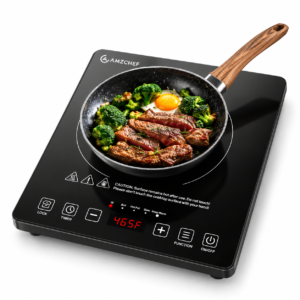
For families who want a quiet indoor option that does not rely on propane or an open flame, a portable electric cooktop such as the AMZCHEF Portable Induction Cooktop can be paired with a properly sized battery power station.
We’ll cover that in detail in our next guide: How to Cook During a Power Outage: Safe Indoor Options Without Gas
Build What Your Family Will Actually Use
Do not fill your pantry with foods your family hates just because they have a long shelf life.
Consider:
food allergies, medical diets, children’s preferences, elderly family members, pets, religious or dietary restrictions, and foods everyone already knows how to prepare.
You are building your family’s system.
Not somebody else’s.
A Simple Starting Goal
If you are brand new to emergency food storage, keep it simple.
Start with three days.
Then seven days.
Then two weeks.
Then one month.
After that, decide whether you want a deeper reserve.
You do not have to buy everything at once.
Add a few extra shelf-stable items during normal grocery trips.
Rotate them.
Replace what you use.
Build gradually.
A strong pantry is usually built over time, not during one giant shopping trip.
Rooted & Ready Action Step
Today, look at the food already in your home.
Ask yourself:
If we could not shop for seven days, could we eat comfortably with what we already have?
If the answer is no, do not panic.
Write down five shelf-stable foods your household already eats and add one or two of them during your next grocery trip.
Then keep building.
One week becomes two.
Two weeks becomes a month.
And little by little, your pantry becomes a source of peace instead of stress.
Prepared in Peace. Rooted in Christ.
Affiliate Disclosure: Some links in this article may be affiliate links. Rooted & Ready may earn a small commission when you make a qualifying purchase through these links, at no additional cost to you. We recommend products we believe may be useful in building practical, peaceful preparedness.